Saturday, July 11, 2026

Witness and warnings: will the world's leaders listen?

As the 80th anniversary of the Hiroshima and Nagasaki bombings passed in 2025, the voices and of the survivors of the attacks - the hibakusha (literally, explosion-affected people) bore powerful and tragic testimony to the unthinkable humanitarian cost of nuclear weapons. 

In Ireland, Irish CND and Afri (both members of ICAN, the International Campaign to Abolish Nuclear Weapons) were privileged to host Kyoko Gibson, a second-generation hibakusha from Hiroshima, now living in Wales. Kyoko spoke eloquently at a number of events, including a secondary school visit, student talks in TCD and TUD, and an open meeting in the Quaker meeting house in Dublin city centre. She also visited Leinster House to meet with John Lahart TD, chair of the Oireachtas committee on Foreign Affairs. 

She described her experiences as a child growing up in the aftermath of the bombing in Hiroshima, and her involvement in the campaign for world peace and the abolition of nuclear weapons, in a deeply moving plea to support and continue her campaigning work. 

Kyoko Gibson speaking in Trinity College, Dublin, in October 2025, with Katie Martin (Afri), Iain Atack (Afri), and David Hutchinson Edgar (Irish CND)

Kyoko Gibson's address to the No More Hiroshimas event in Trinity College, co-hosted by the School of Religions, Theology and Peace Studies, can be viewed here, along with responses from Prof. Iain Atack and Dr David Hutchinson Edgar, representing Afri and Irish CND. 

The message shared with us by Kyoko Gibson, in common with that of other hibakusha, speaks of the utter depravity of such weapons of mass destruction, and the unspeakable horrors of their lasting impact on those affected. 

The bomb dropped on Hiroshima in 1945 was small compared with the destructive capacity of today's nuclear arms, even the so-called "tactical" weapons in the arsenals of the United States and Russia. The catastrophic humanitarian and environmental effects of any use of a nuclear weapon today do not bear thinking about. As the International Committee of the Red Cross / Red Crescent has pointed out, the destruction of medical and other infrastructure in a nuclear attack would make it impossible to have any kind of organised aid response in the attack's aftermath. The consequent suffering would be enormous. 

More than eighty years on, the world faces a polycrisis of war, climate change, biological threat and technological disruption, as noted by the Bulletin of Atomic Scientists in setting the Doomsday Clock at 85 seconds to midnight, symbolically the closest it has ever been to apocalypse. 

With Russia, the United States, and Israel all involved in international conflict, and cross-border exchanges between India and Pakistan - all nuclear-armed states - in the past year, it is clear that nuclear weapons do not prevent wars or bring stability to the international order. The presence of nuclear weapons in a volatile and unstable world increases the risk of annihilation. 

The witness and warnings of the hibakusha, and of international medical, humanitarian and scientific experts, must be listened to with renewed acuity. It is our responsiblity to magnify their voices and their testimony to a level that can no longer be ignored by world leaders: No More Hiroshimas.


Tuesday, August 5, 2025

80 years on: Commemoration of the Hiroshima bombing, August 6 2025

On Wednesday 6th August 2025, Irish CND marked the 80th anniversary of the Hiroshima bombing, holding the annual commemoration ceremony at the memorial cherry tree in Merrion Square in Dublin. 

Welcoming the largest attendance for several years, Irish CND chairperson Dr David Hutchinson Edgar reminded them of the unimaginable horrors inflicted 80 years previously and evoked the determination of those present not just to remember, but to do all they can to ensure such events can never happen again, noting the role Ireland has played in recent years in the development of the Treaty on the Prohibition of Nuclear Weapons.  

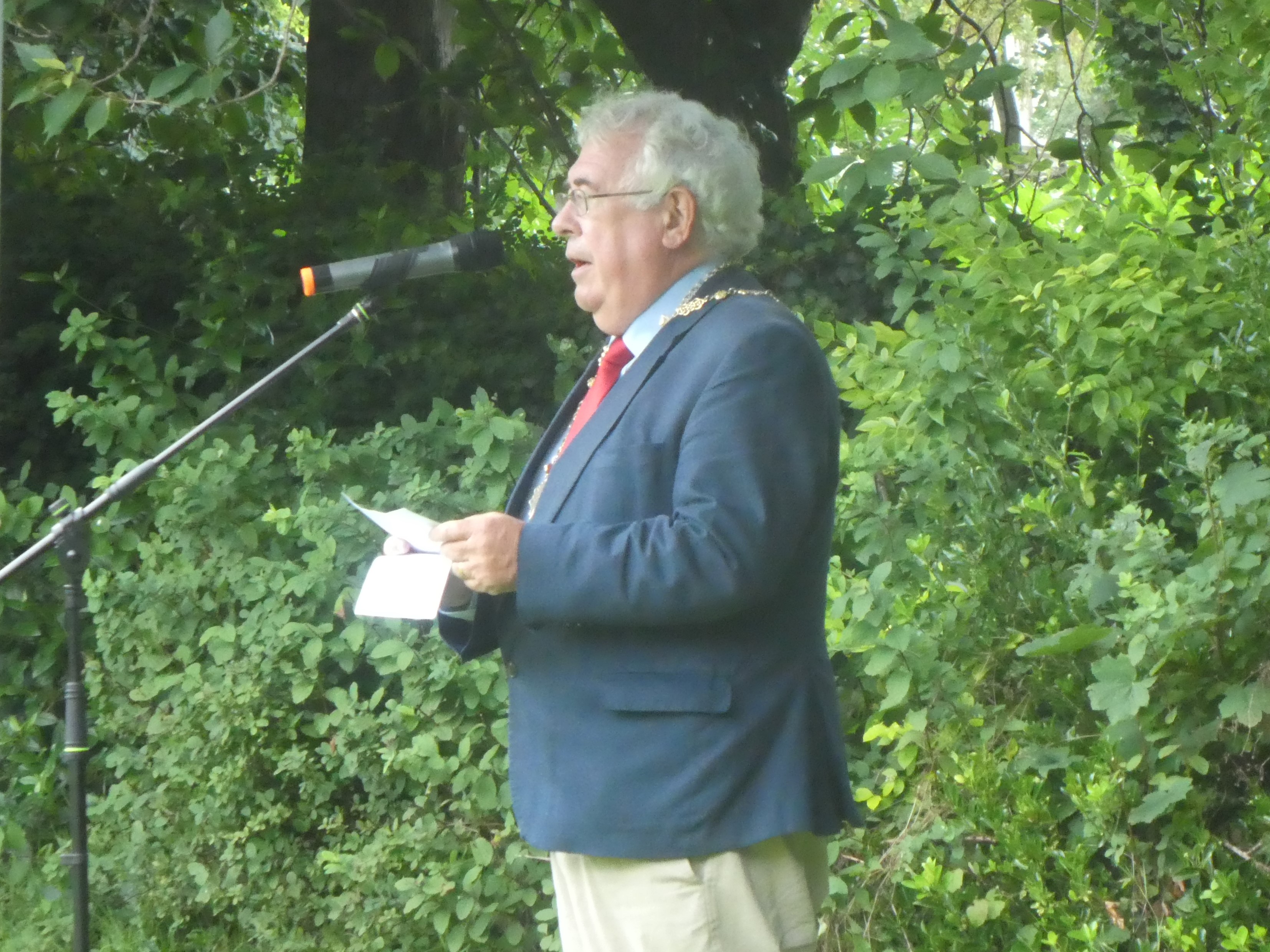
Speaking on behalf of the people of Dublin, Deputy Lord Mayor John Stephens spoke of how it is imperative not only that nuclear weapons are never used, but that the threat of nuclear warfare needs to be removed from international political and military discourse. "Let the world move on to be a better place to live, to work, to grow old, and rear our families, without the threat of nuclear war," he said. 

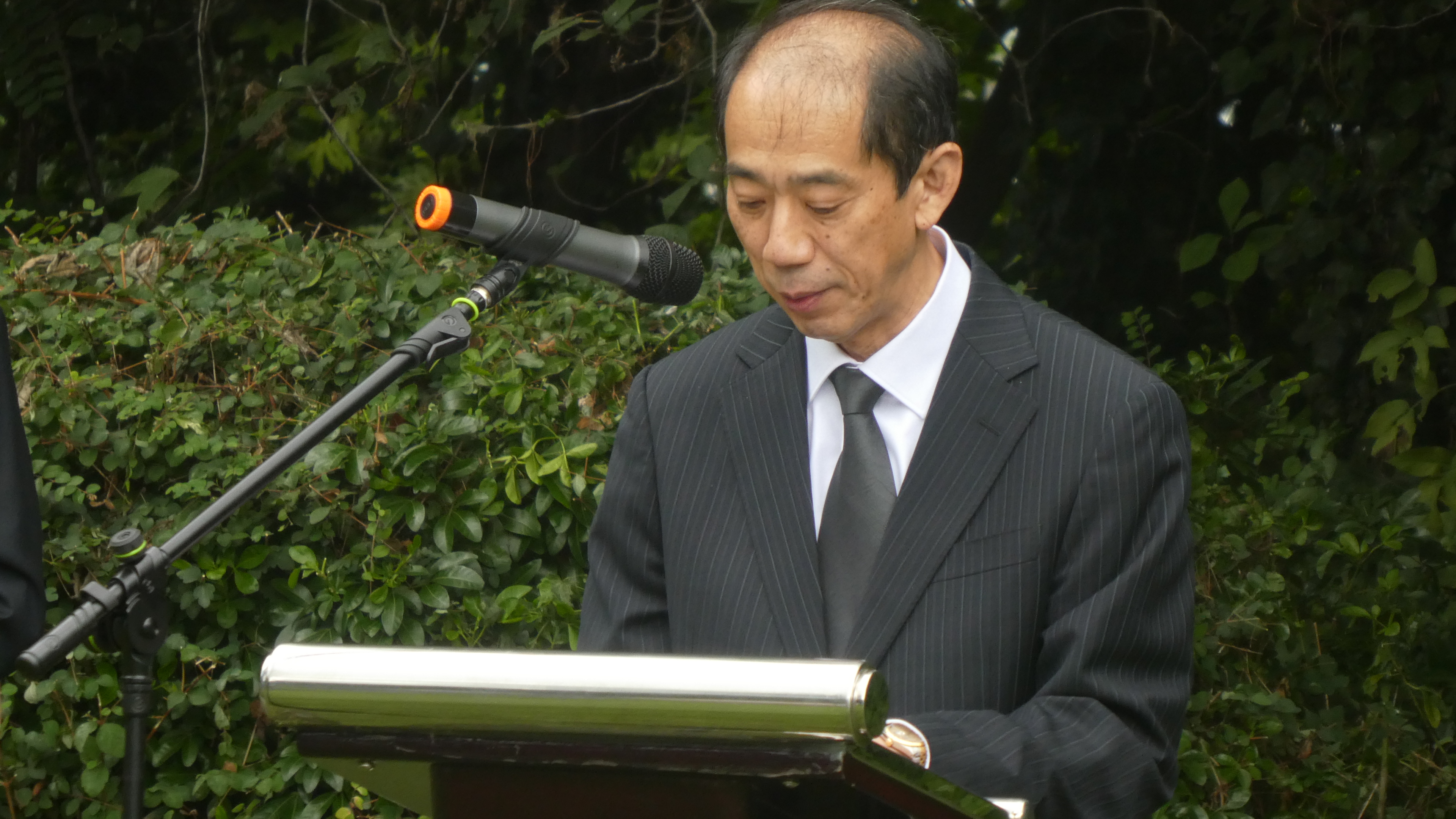
Chargé d'Affaires at the Japanese embassy in Ireland, Mr Norimasa Yoshida, thanked Irish CND for organising the ceremony. Referring to the visit to Dublin last year of the Mayor of Hiroshima, he repeated the message of the bomb victims of 1945, that they must be the last ever to experience the utter horror of a nuclear attack. Diplomats from Austria, Brazil, Egypt, New Zealand, South Africa and Ukraine also represented their countries at the ceremony. 

Irish CND vice-president, Adi Roche, paid tribute to eight decades of both suffering and campaigning for peace on the part of the hibakusha (literally, "explosion-affected people") of Hiroshima and Nagasaki: 

"Those wonderful people, the Hibakusha, by their speaking out and giving witness are our teachers encouraging us towards Courage. They are our teachers in leading us to Conviction. They are our teachers of Care, Compassion and Love, encouraging us all, inspiring us today to take up the struggle for peace and nuclear disarmament, ensuring that horrors like Hiroshima and Nagasaki will never happen again."

She continued: "The personal stories of the Hibakusha humanise history and lift the veil of our forgetfulness and call us to remember and learn. Their stories bridge that gap between those who were there and those of us who are untouched by the violence of these events. The Hibakusha help us describe the indescribable, to think the unthinkable, to somehow grasp the incomprehensible pain and suffering caused by nuclear weapons. The Hibakusha are the living reminders of what is at stake: our humanity, our civilisation; we are perilously close to the precipice."


Extracts from the Nobel Peace lectures by Setsuko Thurlow (on behalf of ICAN, 2017) and Terumi Tanaka (on behalf Nihon Hidankyo, 2024) describing their eyewitness recollections of the immediate aftermath of the bombings, were read by Barbara Comerford (Irish CND) and Joe Murray (Afri). Poet Eriko Tsugawa read the poem "At the makeshift aid station" by Toge Sankichi. Eight white roses were laid at the base of the cherry tree as the names of eight victims of the bombings were read out, symbolically representing both the eight decades since 1945, and the 80,000 men, women and children killed on 6th August 1945. 

Musical contributions by Máire Ní Bheaglaíoch and Seán Dunne called to mind both the sense of mourning and solemnity which characterised the memorial aspects of the ceremony, as well as the vigorous resolve to work to free the world of nuclear weapons. The ceremony concluded with the laying of a wreath at the cherry tree and the observation of a minutes' silence. 

Sunday, June 22, 2025

Nuclear War: Is this the final countdown?

Nine states possess nuclear weapons: the United States, Russia, China, France, the United Kingdom, India, Pakistan, Israel and North Korea. In the first sixth months of 2025, more than half of these states have attacked other countries. Russia continues its war on Ukraine, with the Chernobyl and Zaporizhzhia nuclear sites at ongoing risk of catastrophic damage. India and Pakistan engaged in missile and drone strikes against each other in early May. Israel has compounded its war on Gaza with attacks on civil nuclear facilities in Iran and assassinations of Iranian leaders. In the past few days, the United States has joined Israel in attacking Iran's nuclear facilities, despite no credible evidence that Iran, a signatory to the Nuclear Non-Proliferation Treaty which has consistently denied it is attempting to attain nuclear weapons, was developing nuclear arms. 

This demonstrates, perhaps, that states which possess nuclear weapons believe they can act with impunity and disregard the normal conventions of international law and diplomacy by engaging in armed aggression against other countries. 

The hypocrisy of states, which themselves are in blatant contravention of international nuclear disarmament and non-proliferation agreements, carrying out an attack on another state on the pretext of preventing it developing nuclear weapons, is staggering. Attacks on nuclear installations of any kind risk significant environmental damage, as well as the potential impact in terms of human casualties. 

More worryingly, it represents a dramatic decline - even a collapse - in the international order, with the structures for seeking diplomatic solutions dangerously close to being replaced to unprecedented international violence on the part of those seeking to reshape the world in their own interests. If this trend continues, the humanitarian and environmental consequences are unthinkable. It is, tragically, hard to avoid the expectation that such untrammeled recourse to international violence outside of any legal framework by nuclear-armed states will not, sooner or later, lead to the use of nuclear weapons. 

When that moment comes, there is no way back from annihilation. 

Weapons of mass destruction in the hands of rapacious aggressors do not make the world a safer place. They hasten the end of the world as we know it. The Bulletin of Atomic Scientists has warned that we are closer than ever before to nuclear war, and the events of recent months, weeks and days show how rapidly international violence can escalate. Are we entering the final countdown to destruction?

Irish CND unreservedly condemns all acts of international aggression and urges the use of diplomatic solutions to resolve international disputes. We call on the Irish government to be unambiguous in its condemnation of such attacks, and in its support for international fora committed to peaceful resolution of conflicts, and in particular, the role of the United Nations as a force for peace. There is no room for prevarication. 

In light of the most recent developments, we urge the Irish government to ensure that Irish airports, airspace and territorial waters are not used for the transport of military hardware and personnel by any country engaged in international aggression. 

At at time when the role of the United Nations is being seriously weakened by the aggression of nuclear-armed states, we urge the Irish government to desist from any action which diminishes the role of the UN in Irish foreign policy, particularly in relation to the current debate on the circumstances of the deployment of Irish soldiers in peace-keeping missions. 

Nuclear-buttressed international attacks lead only along a downward trajectory towards destruction. We join our global partners in the International Campaign to Abolish Nuclear Weapons in calling for re-commitment to the Nuclear Non-Proliferation Treaty, and full implementation of its provisions, and in calling for the universalisation and full implementation of the Treaty on the Prohibition of Nuclear Weapons. 

Monday, March 3, 2025

Nuclear Ban Treaty needed more than ever in an uncertain world

The third Meeting of States Parties (MSP) to the Treaty on the Prohibition of NuclearWeapons gets underway at the United Nations in New York on 3rd March 2025. Civil society organisations will also participate in events during Nuclear Ban Week, including the International Campaign to Abolish Nuclear Weapons (ICAN), of which Irish CND is a member. 

Photo: ICAN

Nuclear-armed states remain engaged in deadly conflicts in Ukraine and in the Middle East. Rhetoric around the possible use of nuclear weapons in these conflicts has been deeply regrettable, and risks lowering the bar to a dangerous level in discourse on the acceptability of using so-called tactical nuclear weapons, many of which are far more powerful than the bombs which annihilated Hiroshima and Nagasaki in 1945. The weaponisation of nuclear facilities likewise casts a frightening shadow of potential destruction.

Nuclear-armed states are pouring vast sums of money into modernising and expanding their deadly arsenals. The United States, in contravention of its commitments under the Nuclear Non-Proliferation Treaty (NPT), continues to station nuclear warheads in Europe. Russia has recently followed suit by moving nuclear arms to neighbouring Belarus. Preparations are reportedly underway for the return of American nuclear weapons to the UK

In January 2025, the Bulletin of Atomic Scientists moved the Doomsday Clock to 89 seconds to midnight, the closest point to symbolic doom it has ever represented. Their in-depth analysis of the nuclear threat stated: “Longstanding concerns about nuclear weapons—involving the modernization and expansion of arsenals in all nuclear weapons countries, the build-up of new capabilities, the risks of inadvertent or deliberate nuclear use, the loss of arms control agreements, and the possibility of nuclear proliferation to new countries—continued or were amplified in 2024.” The increasing threats from climate change, biological risks and disruptive technologies all likewise fed into the Bulletin’s negative appraisal.

Even in this bleak scenario, there is hope.

The TPNW explicitly outlaws nuclear weapons, and has now been signed or ratified by almost half the UN membership. The Treaty sets out a clear framework on advancing nuclear disarmament as required by Article 6 of the NPT, and contains vital provisions for victim assistance and environmental remediation, recognising the disproportionate harm caused by nuclear weapons and related activities on women and girls, and on indigenous peoples.

Work on progressing these aspects of the Treaty, as well as on the humanitarian consequences of nuclear weapons, the compatibility of the Treaty with the NPT (an area headed up by Ireland), and the fallacy of nuclear deterrence will be among the themes discussed during the meeting.

Recent research by ICAN and PAX has shown that the stigmatisation of nuclear weapons since the entry into force of the TPNW in 2021 has prompted a marked drop-off in financial institutions investing in companies directly involved in the nuclear weapons industry, with a 23% reduction over less than four years. Both AIB and Bank of Ireland are listed among more than 100 institutions whose investment policies now explicitly exclude nuclear weapons companies. The exclusion of nuclear weapons in their current investment policies reflects the impact of Prohibition of Nuclear Weapons Act (2019), which gave effect to the provisions of the TPNW in Irish law.

A proposal to establish an expert panel to examine the potential effects of nuclear war, put forward by Ireland and New Zealand, was overwhelmingly approved by the UN General Assembly in 2024. Work on this expert report is expected to get underway this year, with the report due in 2027. This will be the first report of its kind for several decades, and should serve as a timely reminder of inevitable annihilation that would be intrinsic to nuclear war.

Several times since returning to power in the United States, President Donald Trump has outlined his intention to engage in nuclear disarmament negotiations with Russia and China “in a very big way.” Referring to the costs of the nuclear weapons programme, he spoke of how this represents “spending a lot of money that we could be spending on things that are actually hopefully much more productive.” Considering the possibility that nuclear weapons might ever be used, he concluded his comments with “That’s going to be a very sad day. That’s going to be probably oblivion.”

Campaigners and non-nuclear states having been saying this clearly for decades, so it is encouraging to hear the leader of the country with one of the world’s largest caches of nuclear arms speak in such terms. We hope that his counterparts in Russia and China – and in the other nuclear-armed states – will join him and will match words with actions.

If President Trump is indeed serious about nuclear disarmament, then there is already a clear pathway to that goal, through engaging with the TPNW processes and verifiably putting nuclear weapons out of existence. The USA spent $51.5 billion dollars on nuclear weapons in 2023, over half of the total outlay among nine nuclear-armed states of more than $91billion. It does not take either a genius or a president to work out that such vast amounts of money could and should be spent on things that are, in President Trump’s words, “much more productive”.

There is hope.

Thursday, January 2, 2025

Nihon Hidankyo awarded 2024 Nobel Peace Prize

The 2024 Nobel Peace Prize has been awarded to Nihon Hidankyo, the Japanese Confederation of Atomic and Hydrogen Bomb Sufferers Organizations, with the award presented at the annual ceremony in Oslo on 10th December. The ceremony, including the Nobel Lecture delivered by Terumi Tanaka, can be viewed online here.

The award recognizes Nihon Hidankyo, in the words of the Nobel Committee, “for its efforts to achieve a world free of nuclear weapons and for demonstrating through witness testimony that nuclear weapons must never be used again.”

Despite immense personal suffering as a result of the impact of the bombs that annihilated Hiroshima and Nagasaki in 1945, survivors of the blasts have borne unfailing witness to the horrific humanitarian consequences of any use of nuclear weapons. Their experience and advocacy stand out in the struggle to rid the world of these merciless weapons of mass destruction.

The Irish Campaign for Nuclear Disarmament congratulates Nihon Hidankyo on the award of the Nobel Peace Prize, recognizing the power of their courage and determination in exposing the ghastly truth about nuclear weapons, often while battling the personal scars of ill-health, social stigma and advancing age.  

No nuclear weapon has been used in nearly 80 years, but today the number of nuclear-armed and nuclear-capable states is growing. Nuclear arsenals across three continents are being modernized at vast expense.

International treaties limiting nuclear arms stocks have been ended or shelved. Discussions on the future of the Nuclear Non-Proliferation Treaty, for long considered the bedrock of a supposedly safe nuclear order, broke up earlier this year without agreement.

Bellicose rhetoric invoking the real possibility of the use of nuclear weapons – taboo for many years – has become an all-too-frequent feature of statements by politicians in nuclear-armed states, including Russia and the United States, who still hold over 90% of the global nuclear stockpile.

Even the so-called smaller “tactical” nuclear weapons of today are generally more powerful, more destructive than those which inflicted such destruction on Hiroshima and Nagasaki nearly 80 years ago.

If nuclear weapons are ever used again, the scale of destruction will inevitably be far greater than that which caused such suffering to the survivors of Hiroshima and Nagasaki. Far too many “near-misses” have already been documented. While nuclear warheads remain ready to fire, life on earth as we know it remains just minutes away from an apocalyptic end.

We have been dependent on luck to avoid that fate for too long. Sooner or later, whether through malice, machismo, miscalculation or malfunction, that luck will run out.

Twice in the past decade, the Nobel Peace Prize has been awarded to an organization highlighting the horror of nuclear warfare and calling for an end to nuclear weapons. In 2017, the International Campaign for the Abolition of Nuclear Weapons (ICAN, of which Irish CND is a member), also received the award for its work, particularly its efforts to create an international treaty explicitly outlawing nuclear weapons, which came into force in 2021 as the Treaty on the Prohibition of Nuclear Weapons.

The voices of those who survived the atomic bombs of 1945, invoking in turn the silence of the hundreds of thousands more who did not survive, need to be heard more than ever today.

We cannot afford not to listen.

Irish CND, together with our colleagues across the world working for the abolition of nuclear arms, calls on all states to ratify the Treaty on the Prohibition of Nuclear Weapons. We call on the leaders of nuclear-armed states, in particular, to heed the call of those who have experienced the utter depravity of nuclear warfare, and to put their countries’ stocks of nuclear warheads out of use forever.

Tuesday, August 13, 2024

Hiroshima remembered, 79 years on

Seventy-nine years on from the bombing of Hiroshima on 6th August 1945, Irish CND commemorated the horrific events of the first use of an atomic bomb. The ceremony of words and music took place at the memorial cherry tree, planted by Irish CND in 1980, in Merrion Square Park in Dublin. 

Speaking at the ceremony, Deputy Lord Mayor Donna Cooney highlighted how the Bulletin of Atomic Scientists' Doomsday Clock has again been set at 90 seconds to midnight for 2024, the closest to the symbolic point of destruction it has ever been. She noted that this decision was influenced by the gravity of the threat posed by both nuclear war and climate change, and called for decisive action to reverse both these existential threats: "Both nuclear weapons and climate change are manmade threats to life as we know it. The power to limit, to reverse and to undo these threats lies in our hands also."

She also stated Dublin's commitment to the vision of Mayors for Peace, chaired by the Mayor of Hiroshima. She paid tribute to Ireland's role in working internationally for nuclear disarmament, noting in particular Ireland's contribution to bringing both the Non-Proliferation Treaty (1970) and the Treaty on the Prohibition of Nuclear Weapons (2021) into being, recognising the role of an explicit ban in "stigmatising and de-legitimising the possession of nuclear weapons." 

Deputy Lord Mayor of Dublin, Donna Cooney, speaks at the Hiroshima Commemoration, watched by the Japanese Ambassador, His Excellency Mr Norio Maruyama.

Irish CND vice-president, Adi Roche (CEO of Chernobyl Children International), powerfully evoked the horrors of the bombing, and of any future nuclear conflict. She strongly criticised the obscene levels of military spending by nuclear-armed states: "The people of the world have played the ultimate price with hunger, poverty, homelessness, unemployment and of course environmental degradation, while the big powers have endless funding for militarism and the development of weapons such as nuclear weapons, while on the other hand slashing the budgets for building schools, hospitals, healthcare, housing, and creating employment." 

She praised the international contribution Ireland has been able to make as a neutral country, through its diplomatic roles and through its participation in UN peacekeeping operations, and called for the protection and constructive development of Ireland's neutrality. 

Referring to the spectre of war in today's world, she decried the disturbance caused to radioactive soil by Russian military movements through the Chernobyl region, and the potential for an unprecedented nuclear disaster through the weaponisation of the Zaporizhzhia nuclear power plant

Irish CND vice-president, Adi Roche, addresses the commemoration. 

Despite the seriousness of the current situation in Ukraine, the Middle East and in other parts of the world torn by violence, her message concluded with an urgent positive appeal to the power of love and reconciliation to overcome even the deepest divisions: a challenge for all those present to take away and put into action. 

The Japanese ambassador to Ireland, His Excellency Mr Norio Maruyama, spoke of Japan's unique role in pursuing a vision of a world free of nuclear weapons, as the only country to have suffered the trauma of atomic bombing. He received warm applause in response to his announcement that the Mayor of Hiroshima would visit Ireland in October, the first time such a visit has taken place. 

Representatives of some of Ireland's partner countries in working for nuclear disarmament were also in attendance, with diplomats from Austria, Egypt, New Zealand and South Africa, as well as from the Disarmament Unit in the Department of Foreign Affairs, present at the ceremony.  

Poet Eriko Tsugawa gave a moving bilingual performance of her poem, Hiroshima, Not This Way, and contributions from traditional accordionist Máire Ní Bheaglaíoch gave musical expression to the sombre remembrance of all victims of atomic and nuclear testing and bombing. The ceremony concluded with the laying of a wreath by Deputy Lord Mayor Cooney, and the observation of a minute's silence. 

Ambassador Maruyama, Deputy Lord Mayor Cooney, Irish CND vice-president Adi Roche, and Irish CND chairperson David Hutchinson Edgar at the memorial cherry tree in Merrion Square. 


Friday, July 26, 2024

Can we step back from the brink?

The dark shadow of the possibility of nuclear war looms more grimly than perhaps ever before. Russian nuclear weapons are now stationed in Belarus. Plans to resume the stationing of US nuclear weapons in the UK have been widely reported. Spending on nuclear weapons reached more than $90 billion last year, a shocking new high. Nuclear weapons states are all engaged in modernising their arsenals and delivery systems. We've heard bellicose rhetoric about the potential use of nuclear weapons from government representatives in Israel and Russia, and from Republican lawmakers in the United States. 

It would only take a moment of madness to plunge the world into an irreversible nuclear war. Can we step back from the brink?

We must meet darkness with positive hope and determination. 

This year we mark the 79th anniversary of the Hiroshima bombing, which took place on 6th August 1945. Irish CND will be hosting the customary annual commemoration in Merrion Square in Dublin. The ceremony will take place at the memorial cherry tree in Merrion Square Park, at 1.10 p.m. 

There will be short speeches by Deputy Lord Mayor Donna Cooney, Japanese ambassador Mr Norio Maruyama, and Irish CND vice-president Adi Roche (CEO of Chernobyl Children International). There will also be contributions of music and poetry, and a wreath of flowers will be laid at the tree at the close of the commemoration. 

An estimated 80,000 people were directly killed by the bomb dropped on Hiroshima, with casualties reaching 140,000 by the end of the year. Approximately 14,000 nuclear weapons remain in the world today, enough to destroy life on earth as we know it many times over. 

Wherever you are, even if you are not in a position to join us in person this year, please do join us in spirit to stand in solidarity with the victims of these horrific weapons of mass destruction, and to affirm our determination to work for their elimination, the only way to ensure that the ghastly events of Hiroshima and Nagasaki will not be repeated.

Tuesday, August 1, 2023

Atomic bombing of Hiroshima commemorated in Dublin

The annual commemoration for the victims of the Hiroshima atomic bomb took place at the memorial cherry tree in Merrion Square Park, Dublin, on Sunday, 6th August 2023, the 78th anniversary of the bombing. Despite torrential rain during the ceremony, over 70 people gathered to remember all those affected by nuclear testing and weapons, and to affirm their determination that such an atrocity must never happen again.

Welcoming those in attendance, Irish CND chairperson, Dr David Hutchinson Edgar, paid tribute to the leading roles in working internationally for nuclear disarmament played by Austria, Brazil, Mexico and South Africa, whose ambassadors were present. He noted Ireland's partnership with countries such as these in the New Agenda Coalition, which has recently submitted a strong working paper aimed at breaking what some see as the current stalemate in disarmament negotiations, "Taking Forward Nuclear Disarmament," at the United Nations. He praised Austria's role as host of the first meeting of states parties to the Treaty on the Prohibition of Nuclear Weapons, and acknowledged the vision for a world free of nuclear weapons put forward by Japanese Prime Minister, Fumio Kishida, in the context of the G7 meeting in Hiroshima earlier this year.

Ambassadors from Austria, Brazil, Mexico and South Africa joined representation from the Irish Department of Foreign Affairs, together with Irish CND Chairperson David Hutchinson Edgar, Japanese Ambassador Norio Maruyama and Dublin City Councillor Danny Byrne, who spoke at the ceremony.

Cllr Danny Byrne, representing Dublin City, reminded the audience of the horrors that struck Hiroshima on 6th August 1945, when approximately 80,000 people were annihilated instantly, with casualities reaching 140,000 within a year. He highlighted how each casualty represented not a number, but "human lives with the right to dignity, all terminated by ... the immeasurable brutality of the atomic bomb." He noted that Dublin was the first Irish city to join Mayors For Peace, co-founded by the mayors of Hiroshima and Nagasaki, and re-affirmed Dublin's commitment to the vision of Mayors For Peace: a world free of nuclear weapons, safe and resilient cities, and promoting a culture of peace. Cllr Byrne laid a wreath on behalf of the people of Dublin at the end of the ceremony. 

Cllr Danny Byrne laid a wreath at the memorial tree on behalf of the people of Dublin.

In a recorded message, Irish CND vice-president, Adi Roche, spoke of the threat to life on earth posed both by nuclear weapons and by the weaponisation of civil nuclear facilities in Ukraine, and decried the massive waste of resources represented by nuclear weapons: "Because of the billions spent on weapons development and production, the people of the world have paid the ultimate cost through hunger, poverty, homelessness, unemployment, environmental degradation, while the big powers have endless funding for militarism and nuclear weapons." She praised the positive contributions of Ireland's policy of active neutrality and called for the use of "the power of our intellect, diplomatic abilities and our negotiating talents to bring an end to the current war in Ukraine and beyond."

His Excellency Mr Norio Maruyama, Japanese ambassador to Ireland, reflected on Japan's unique responsibility in relation to nuclear disarmament as the only country which has suffered an atomic bomb attack. He spoke of Prime Minister Kishida's initiative to promote nuclear disarmament among his colleagues in the G7 group of countries, and reiterated Japan's determination to keep working until nuclear weapons have been eliminated. 

Japanese ambassador, His Excellency Mr Norio Maruyama, spoke through heavy rain at the ceremony.

Musicians Máire Ní Bheaglaíoch (accordion) and Philip Horan (Japanese flute) contributed several pieces of reflective traditional music during the ceremony, which for many of those present, expressed a depth of feeling beyond words in response to the horror of nuclear weapons. Misato Omori read the poem, "That's my home", by Ukrainian poet Anastasia Afanasieva, reflecting on the personal impact of the horrors of war. 

Misato Omori read the poem "That's my home," by Anastasia Afanasieva.

Approximately 14,000 nuclear weapons remain in the world today, with just under 2,000 ready to fire within minutes, more than enough to destroy life on earth as we know it many times over. We call on all people to stand in solidarity with the victims of these horrific weapons of mass destruction, and to affirm our determination to work for their elimination, the only way to ensure that the ghastly events of Hiroshima and Nagasaki will never be repeated. 

Monday, July 31, 2023

Oppenheimer: Hollywood looks at the origins of nuclear weapons

One of 2023's most anticipated and most heavily advertised movies, Oppenheimer, directed by Christopher Nolan, recreates the role of its title character in the development of the atomic bomb in the 1940s. 

For some, this is an epic feat of cinematic storytelling; for others, the marriage of mass entertainment with the story of the origin of weapons of mass destruction sits somewhat uncomfortably. 

There seem to be two main sub-categories of war movies today, both of which condense the vast horror of 20th century industrial-scale warfare through the lens of a personal narrative. One type focuses on the exploits of the plucky little guy, the challenges faced by the ordinary soldier (like Saving Private Ryan, 1917 or Nolan's earlier work, Dunkirk), while the other is centred on the troubled famous person whose decisions have far-reaching consequences (like Oppenheimer, Enigma or Darkest Hour). 

With this focus on one person's story, there is much that any movie must leave untold, and that has inevitably provided one of broad areas of criticism of Nolan's Oppenheimer. The views, indeed the work, of other scientists appear as a backdrop to those of the central character. Female characters are little more than a foil to illustrate the personal struggles of the male protagonist in a male-dominated world. Residents of the area around the test site are barely mentioned. The depiction of the impact of the explosion - heat, light, sound, radiation - while dramatic, is tame compared to what it would really have been. The myth that the bombing ended the war (by no means certain) is perpetuated. 

Perhaps most seriously, the shattering real-life humanitarian impact of the use of the atomic bomb is never explicitly shown, though it is briefly alluded to. 80,000 people were annihilated in Hiroshima, and another 60,000 in Nagasaki, with many thousands more suffering horrific injuries leading to their deaths in the subsequent months and years. 

Both through its successes (the complex portrayal of its main character, and his growing deep unease with the bomb project) and its shortcomings, the film provokes reflection on the exploitation of scientific knowledge for purposes of destruction, and in particular, on the threat to life on earth as we know it posed by nuclear weapons. As we approach the anniversary of the bombings of Hiroshima and Nagasaki, the urgency of creating a world free of nuclear weapons has never been greater or more apparent. 

Here is a short selection of further resources discussing the significance of Oppenheimer
Everyone can help forge a safe ending to what Oppenheimer began by Prof. Tilman Ruff of the University of Melbourne, Past President of IPPNW and co-founding member of ICAN, published by the University of Melbourne 


Facts and Myths about Oppenheimer compiled by ICAN, the International Campaign to Abolish Nuclear Weapons

Post-Oppenheimer: What We Should Do To Dismantle Nuclear Weapons by Prof. Ivan Nikolić Hughes of Columbia University, President of Nuclear Age Peace Foundation, published by the Bulletin of Atomic Scientists 

Friday, July 29, 2022

Annual commemoration of the atomic bombing of Hiroshima, 6th August

The annual commemoration for the victims of the Hiroshima atomic bomb took place on Saturday, 6th August 2022, the 77th anniversary of the bombing, at the memorial cherry tree in Merrion Square park, Dublin 2.

Opening the ceremony, Deputy Lord Mayor of Dublin Darcy Lonergan spoke of the need for hope in the face of a world once again threatened by the possibility of nuclear war. She praised the work of Irish diplomats over the years for their key role in bringing both the Non-Proliferation Treaty and, more recently, the treaty on the Prohibition of Nuclear Weapons to reality. 

Deputy Lord Mayor Darcy Lonergan speaking at the 2022 Hiroshima commemoration ceremony.

Mr Mitsuru Kitano, the Japanese Ambassador to Ireland, noted that the current prime minister of Japan comes from Hiroshima, and cited Prime Minister Kishida's recent reiteration, at the Non-Proliferation Treaty review conference at the United Nations, of Japan's commitment to working for a world without nuclear weapons. 

The Japanese ambassador to Ireland, Mr Mitsuru Kitano, addressing the annual Hiroshima commemoration in Merrion Square. 

The President of Irish CND, Canon Patrick Comerford, was unable to attend, and Irish CND chairperson, Dr David Hutchinson Edgar, read out a short reflection by Canon Comerford in his absence. 


Traditional musician Máire Ní Bheaglaíoch contributed several pieces of reflective music on the accordion, and poet Eriko Tsugawa read her poem, "Lull in the rain", the title poem from her collection which received the Hideo Oguma Japanese Poetry Award this year. 

Irish CND Chairperson, Dr David Hutchinson Edgar, spoke of the importance of meeting the threat of nuclear weapons and the reality of violence in the world today with a strong voice for peace and hope, quoting the closing words of the Vienna Declaration, agreed at the first Meeting of States Parties to the Treaty on the Prohibition of Nuclear Weapons in June 2022:

"We have no illusions about the challenges and obstacles that lie before us in realizing the aims of this Treaty. But we move ahead with optimism and resolve. In the face of the catastrophic risks posed by nuclear weapons and in the interest of the very survival of humanity, we cannot do otherwise. We will take every path that is open to us, and work persistently to open those that are still closed. We will not rest until the last state has joined the Treaty, the last warhead has been dismantled and destroyed and nuclear weapons have been totally eliminated from the Earth."

At the close of the ceremony, the Deputy Lord Mayor laid a wreath at the base of the cherry tree, followed by the observation of a minute's silence in memory of all victims of atomic and nuclear bombing and testing. 


Monday, July 18, 2022

First Meeting of TPNW Member States takes place in Vienna

After entry into force of the Treaty on the Prohibition of Nuclear Weapons (TPNW) in January 2021, the first meeting of states parties to the treaty took place in Vienna from 21st - 23 June 2022. 

The meeting formed the climax of Nuclear Ban Week, co-ordinated by the International Campaign to Abolish Nuclear Weapons (ICAN). Events kicked off with a two-day civil society Nuclear Ban Forum, and also included meetings of Youth for TPNW, the inaugural Parliamentarians for TPNW Conference, and a conference on the humanitarian impacts of nuclear weapons organised by the Austrian government. 

Ireland's initial statement in the opening debate of the Meeting of States Parties offered a reminder of how the continued existence of nuclear weapons undermines international security: "It is our fundamental belief that nuclear weapons offer no security. And we know that no amount of resources could provide an adequate humanitarian response to nuclear weapons use. We know that nuclear rhetoric serves to heighten risks and drive escalation in conventional conflict."

As part of the meeting proceedings, Ireland co-sponsored working papers on the complementarity between the TPNW and existing disarmament and non-proliferation frameworks , and on the gender provisions of the TPNW , which highlights the disproportionate impact of nuclear detonations on women and children. Ireland also co-hosted a side event on Gender-Responsive Disarmament, along with WILPF and several other organisations. 

Addressing the Meeting on behalf of the 635 civil society organisations worldwide who are part of ICAN, Beatrice Fihn, ICAN's Executive Director, stressed the urgency of moving forward with nuclear disarmament: "the need for the treaty is clearer and more urgent than ever. Russia’s illegal invasion of Ukraine and its threats to use nuclear weapons have increased the already unacceptable risks of use, and brought the terrible prospect of nuclear war and the catastrophic humanitarian consequences of the use of nuclear weapons to the forefront of public consciousness. The TPNW community must act decisively against such threats, and do everything possible to prevent the use of nuclear weapons"

Irish CND welcomes the agreement and publication of an ambitious Declaration and a 50-point Action Plan on the further implementation of the TPNW as key outcomes of the Vienna meeting. 

As the concluding paragraph of the Vienna Declaration states: "We have no illusions about the challenges and obstacles that lie before us in realizing the aims of this Treaty. But we move ahead with optimism and resolve. In the face of the catastrophic risks posed by nuclear weapons and in the interest of the very survival of humanity, we cannot do otherwise. We will take every path that is open to us, and work persistently to open those that are still closed. We will not rest until the last state has joined the Treaty, the last warhead has been dismantled and destroyed and nuclear weapons have been totally eliminated from the Earth."

Thursday, February 24, 2022

Irish CND statement on Russian invasion of Ukraine

Many people across not just Europe but the entire world will have reacted with shock, fear, horror and even despair at the news that Russian armed forces have launched a multi-pronged attack on Ukraine. A major act of military aggression by a nuclear-armed power raises the prospect of huge civilian casualties and a humanitarian disaster for the population of Ukraine, even without the use of nuclear weapons. The real possibility that nuclear weapons could be engaged in any ongoing conflict risks damage to human life and the environment on an unprecedented, terrifying and utterly catastrophic level.  

War represents not just an immediate failure of diplomacy, but a long-term failure of decency, imagination, maturity and civilisation on the part of the aggressors, and on the part of those who have stoked fear, suspicion, hostility and confrontation on all fronts. Violence is not an acceptable last resort in any circumstance; it is an expression of basic, de-humanised depravity that devalues and destroys human life, human rights and the fragile balance that sustains our wider environment.  

The immediate outfall of war in death and injury to both soldiers and civilians in the Ukraine is already apparent. Further impacts, as refugees flee from conflict, and infrastructure, including food supplies and health services, is destroyed, inevitably follow rapidly. The medical and humanitarian consequences of a prolonged conflict can only grow larger and more frightening by the day and by the hour.  

News of fighting in the area around the crippled and still-dangerous Chernobyl nuclear power plant is chilling. Today, Ukraine has four nuclear power plants with 15 reactors, which together generate up to 50% of the country's electricity supply. An accidental or deliberate strike on any of these facilities could release radioactive materials on a scale far larger than that of the Chernobyl disaster in 1986. Damage to the electricity grid itself, or failure of back-up systems, could likewise result in a devastating nuclear meltdown at any of these locations. Any such nuclear catastrophe, whether accidental or through deliberate weaponisation of nuclear infrastructure, would have far-reaching effects well beyond the borders of Ukraine or Russia.  

Russian President Vladimir Putin has stated in recent days, "No matter who tries to stand in our way… Russia will respond immediately, and the consequences will be such as you have never seen in your entire history." While his statement does not directly reference nuclear weapons, it is hard to avoid the conclusion that this is an implicit threat to launch a nuclear attack, either against Ukraine or other countries which he perceives as an obstacle to his ambitions. President Putin was joined by Belarussian President Lukashenko to oversee military exercises involving nuclear missiles in the past week. In the coming days, Belarus, which facilitated the Russian invasion from its territory to the north-west of Ukraine, will hold a referendum which would allow Russian nuclear weapons to be based in the country. Such statements and actions reinforce the sense of foreboding that an impending nuclear escalation of the conflict is all-too-possible. The consequences for all life on earth as we know it would be unthinkable.  

Irish CND joins with our colleagues in the International Campaign for the Abolition of Nuclear Weapons (ICAN) in condemning Russia's invasion of Ukraine and veiled threats to use nuclear weapons: "We urge the international community to strongly pressure Russia to engage in dialogue and diplomacy, to return to compliance with the UN Charter, respect international humanitarian and human rights law and join relevant treaties to reduce nuclear weapons risks, including the Treaty on the Prohibition of Nuclear Weapons." 

Irish CND calls on the Irish government to use Ireland's influence as a neutral country and as a member of the United Nations Security Council, to take a courageous, self-determined stance to promote peace through all available and appropriate international fora.  

In June 2021, President Putin and American President Joe Biden issued a joint statement reaffirming that a "nuclear war cannot be won and must never be fought." Less than a year later, the world finds itself facing a real and terrifying threat that a nuclear war could indeed be close at hand. We urge nuclear-armed states, whatever their role in the present conflict, to renounce their horrific potential for mass destruction and abolish their nuclear arsenals. We urge European states hosting American nuclear weapons to cease these arrangements immediately. We urge all states, nuclear-armed and non-nuclear-armed, to sign and ratify the Treaty on the Prohibition of Nuclear Weapons, which entered into force just over a year ago, and provides a clear pathway for a nuclear-weapons-free world.  

Irish CND acknowledges with gratitude the use of briefing materials provided by our colleagues in the International Campaign for the Abolition of Nuclear Weapons, International Physicians for the Prevention of Nuclear War and Beyond Nuclear International in the preparation of this statement.

Friday, August 6, 2021

Annual Hiroshima commemoration takes place in Dublin

On 6th August 2021, the 76th anniversary of the atomic bombing of Hiroshima, the annual commemoration of the horrific events of that day took place in Merrion Square park, Dublin. 

Opening the ceremony, Deputy Lord Mayor of Dublin, Cllr Joe Costello, welcomed guests to the occasion and spoke of his pride in Ireland's contributions to moving nuclear disarmament forward in the international arena, most recently through Ireland's role in bringing the Treaty on the Prohibition of Nuclear Weapons to reality. He welcomed the fact that as a consequence of the Treaty's entry into force earlier in the year, Ireland has divested state-held funds from companies involved in the nuclear weapons industry. He also reaffirmed Dublin's commitment to the goals of Mayors for Peace, welcoming their newly-released Vision for Peaceful Transformation to a Sustainable World.

Deputy Lord Mayor of Dublin, Cllr Joe Costello, speaks at the annual Hiroshima commemoration.

Irish CND president, Canon Patrick Comerford, spoke of the futility of nuclear weapons in the face of a global pandemic, and the other crises the world faces today: global warming, cyber security and human rights abuses, all of which threaten our survival. He denounced the misguided actions of the governments of nuclear-armed states who "continue to spend money needed for health care and research on weapons that are useless against this global threat to our security and our survival."

"Nuclear weapons protect us against none of the threats we face in the world today. They never protected us against the threats the world faced in the past. And they have no place in the world as we face the challenges of the future," he concluded. 

Canon Patrick Comerford, president of Irish CND, addresses the Hiroshima commemoration.

The Japanese ambassador to Ireland, Mr Mitsuru Kitano, welcomed the move by the United States and Russia to extend the New Start treaty for five years, and also acknowledged Ireland's role in international disarmament efforts. He spoke of Japan's commitment to work for a world free of nuclear weapons, and called on all states to strive towards a world without nuclear weapons. 

Ambassador Kitano speaks at the Hiroshima commemoration.

There were contributions of reflective traditional music from violinist Niall Coakley, from the Emigrant Suite, and the slow air Táimse im' chodladh. Eriko Tsugawa-Madden read the original Japanese version of a poem by Tamiki Hara, who witnessed the atomic bombing and its aftermath, while Tony Madden read Eriko's English translation of the poem, "Give me water". 

Reflecting on the torrential rain which fell in the course of the ceremony, Irish CND chairperson, Dr David Hutchinson Edgar, said, "We feel the discomfort of live-giving water falling from the sky. We cannot begin the imagine the experience of death and annihilation raining down from the sky." As the rain cleared, he continued, "Just as the rain gives way to sunshine around us today, we look to the future with hope and determination that no-one will ever have to experience what the people of Hiroshima experienced 76 years ago, the hope not just that nuclear weapons will never again be used, but that one day, soon, nuclear weapons will no longer exist."

Deputy Lord Mayor Joe Costello laid a white wreath, symbolising peace, at the foot of the cherry tree planted by Irish CND in 1980 as a living memorial, while participants observed a minute's silence in memory of all victims of atomic bombing and testing at the close of the ceremony. 

Saturday, March 20, 2021

United Kingdom breaks international treaty obligations with nuclear expansion plans

The government of the United Kingdom has announced its intention to expand its arsenal of nuclear weapons by 40%, which would bring its total to 260 warheads. Each warhead is estimated to have an explosive power of around 100 kilotons, making them significantly more dangerous than the 15 kt bomb which devastated Hiroshima in 1945, causing the death of approximately 140,000 people by the end of the year.

Responding the news, the UN Secretary General's office described the plans as contrary to the UK's obligations under Article VI of the Nuclear Non-Proliferation Treaty (NPT).

Irish CND is shocked and repulsed by this move by our nearest neighbour to increase the capacity of its weapons of mass destruction. At a time when the planet faces existential threats from climate change and global biodiversity loss, not to mention the likelihood of future pandemics in addition to the current Covid-19 crisis, pouring vast sums into the power of destruction is reckless and immoral.

In 2019, the UK spent £7.2 billion on its nuclear weapons. How many doctors, nurses, intensive care beds and ventilators could that money have financed? How many programmes to decarbonise the UK economy and lessen the impacts of climate change could it have supported?

Denouncing the plans, Irish CND chairperson, Dr David Hutchinson Edgar, said: "At a time when the United Kingdom claims to aspire to a renewed role in global leadership, its government has chosen to cling desperately to the flotsam of the failed policies of the 1950s and '60s instead of looking to the future with a meaningful vision of global security. Nuclear weapons have never made the world safer. They can play no part in tackling the genuine crises that the world faces today.

"This egotistical move threatens suffering and death on an unimaginable scale, were these weapons ever to be detonated, either by accident or intentionally. Even if they are never used, this move will still contribute to suffering and death for many, many people, both in the UK and further afield, which could have been averted by putting the huge cost of these weapons to better use. Nuclear weapons are a symbol of shame, not status, for the British government."

"In 2017, the Treaty on the Prohibition of Nuclear Weapons was agreed by a significant majority of UN member states. It entered into force in January 2021. This is clearly what the world wants and needs for nuclear weapons: to consign them to the dustbin of history. We urge the UK and other countries which have not yet done so to follow Ireland's lead in joining the TPNW and committing to a world free of nuclear weapons." 

Beatrice Fihn, Executive Director of the International Campaign to Abolish Nuclear Weapons (of which Irish CND is a partner organisation), stated: “A decision by the United Kingdom to increase its stockpile of weapons of mass destruction in the middle of a pandemic is irresponsible, dangerous and violates international law. While the British people are struggling to cope with the pandemic, an economic crisis, violence against women, and racism, the government choses to increase insecurity and threats in the world. This is toxic masculinity on display.”

“While the majority of the world’s nations are leading the way to a safer future without nuclear weapons by joining the Treaty on the Prohibition of Nuclear Weapons, the United Kingdom is pushing for a dangerous new nuclear arms race.”

The move was also strongly criticised by Mayor Kazumi Matsui of Hiroshima, who stated: "Its implementation would run counter to the nuclear disarmament obligation of NPT States Parties and reverse three decades of nuclear weapon reduction policy by the United Kingdom. Such steps can only result in further acceleration of the arms race and weakening international security and stability."

Friday, January 22, 2021

Nuclear weapons are banned under international law

Nuclear weapons were always immoral. With the entry into force of the Treaty on the Prohibition of Nuclear Weapons (TPNW) on Friday, 22nd January 2021, these abhorrent weapons of mass destruction are also illegal under international law. 

The Treaty explicitly prohibits states from developing, testing, producing, manufacturing, otherwise acquiring, possessing or stockpiling nuclear weapons. It also prohibits the provision of assistance in any of these activities, and bans both the use and the threat of use of nuclear weapons. 

In addition to these prohibitions, the TPNW sets out a framework for nuclear-armed states to renounce their weapons, and contains provisions for the support of victims of nuclear weapon explosions, and for environmental remediation. It also recognises the disproportionate impact of ionizing radiation on women and girls. 

Although initially only binding on the states that have ratified it to date, the TPNW is a significant step in stigmatising and delegitimising the possession of nuclear weapons by less than ten states. Through the entry into force of the TPNW, states opposed to the threat of nuclear annihilation reshape international norms to declare unequivocally that nuclear weapons are unacceptable. 

Ireland has played a key role in the TPNW process, from being one of the states which proposed the negotiation of a new treaty at the UN, through being a key participant in the negotiation process, culminating in Ireland's ratification of the treaty on 6th August 2020, the 75th anniversary of the bombing of Hiroshima. In welcoming the entry into force, Minister for Foreign Affairs, Simon Coveney, stated "The elimination of nuclear weapons is not just a priority of this Government, but one shared by all parties and strongly supported by the Irish people."

Campaigners, activists, diplomats and politicians across the world have all played their part in bringing about this historic moment. ICAN, the International Campaign to Abolish Nuclear Weapons (of which Irish CND is a member), received the 2017 Nobel Peace Prize for its key role in promoting the successful negotiation of the treaty. 

Particular mention, however, needs to made of the hibakusha - the "explosion-affected people", who have carried the terrible legacy of atomic warfare in their bodies, many of whom have dedicated their lives to the cause of liberating the world from nuclear weapons. The dreadful toll taken on the residents of Hiroshima and Nagasaki, as well as those living in the vicinity of nuclear test sites, is powerful testimony to why nuclear weapons must be abolished once and for all.