One of 2023's most anticipated and most heavily advertised movies, Oppenheimer, directed by Christopher Nolan, recreates the role of its title character in the development of the atomic bomb in the 1940s.
Monday, July 31, 2023
Oppenheimer: Hollywood looks at the origins of nuclear weapons
Friday, July 29, 2022
Annual commemoration of the atomic bombing of Hiroshima, 6th August
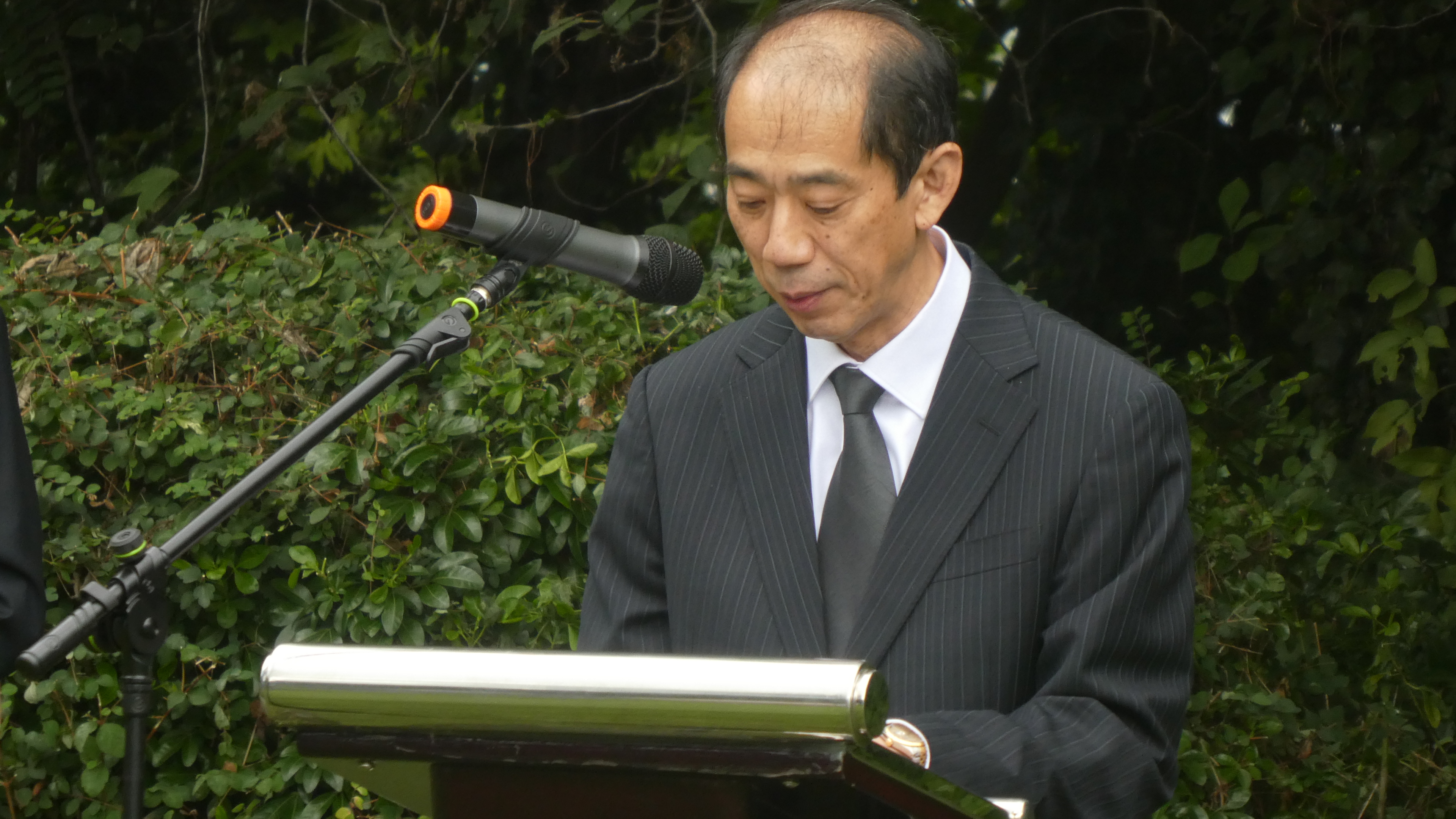
The annual commemoration for the victims of the Hiroshima atomic bomb took place on Saturday, 6th August 2022, the 77th anniversary of the bombing, at the memorial cherry tree in Merrion Square park, Dublin 2.
| The Japanese ambassador to Ireland, Mr Mitsuru Kitano, addressing the annual Hiroshima commemoration in Merrion Square. |
"We have no illusions about the challenges and obstacles that lie before us in realizing the aims of this Treaty. But we move ahead with optimism and resolve. In the face of the catastrophic risks posed by nuclear weapons and in the interest of the very survival of humanity, we cannot do otherwise. We will take every path that is open to us, and work persistently to open those that are still closed. We will not rest until the last state has joined the Treaty, the last warhead has been dismantled and destroyed and nuclear weapons have been totally eliminated from the Earth."
Monday, July 18, 2022
First Meeting of TPNW Member States takes place in Vienna
After entry into force of the Treaty on the Prohibition of Nuclear Weapons (TPNW) in January 2021, the first meeting of states parties to the treaty took place in Vienna from 21st - 23 June 2022.
Thursday, February 24, 2022
Irish CND statement on Russian invasion of Ukraine
Friday, August 6, 2021
Annual Hiroshima commemoration takes place in Dublin
On 6th August 2021, the 76th anniversary of the atomic bombing of Hiroshima, the annual commemoration of the horrific events of that day took place in Merrion Square park, Dublin.
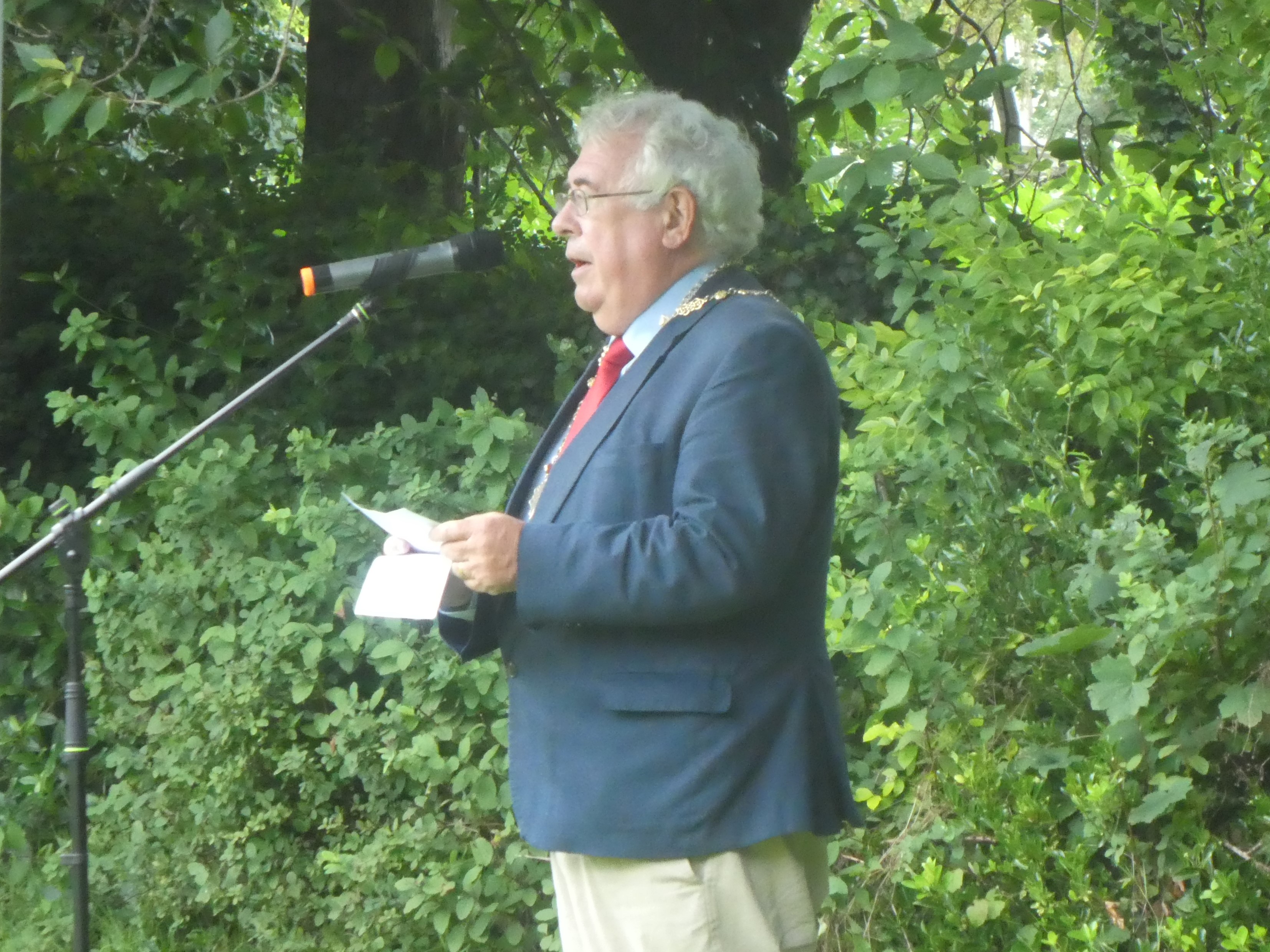
Opening the ceremony, Deputy Lord Mayor of Dublin, Cllr Joe Costello, welcomed guests to the occasion and spoke of his pride in Ireland's contributions to moving nuclear disarmament forward in the international arena, most recently through Ireland's role in bringing the Treaty on the Prohibition of Nuclear Weapons to reality. He welcomed the fact that as a consequence of the Treaty's entry into force earlier in the year, Ireland has divested state-held funds from companies involved in the nuclear weapons industry. He also reaffirmed Dublin's commitment to the goals of Mayors for Peace, welcoming their newly-released Vision for Peaceful Transformation to a Sustainable World.
| Deputy Lord Mayor of Dublin, Cllr Joe Costello, speaks at the annual Hiroshima commemoration. |
Irish CND president, Canon Patrick Comerford, spoke of the futility of nuclear weapons in the face of a global pandemic, and the other crises the world faces today: global warming, cyber security and human rights abuses, all of which threaten our survival. He denounced the misguided actions of the governments of nuclear-armed states who "continue to spend money needed for health care and research on weapons that are useless against this global threat to our security and our survival."
"Nuclear weapons protect us against none of the threats we face in the world today. They never protected us against the threats the world faced in the past. And they have no place in the world as we face the challenges of the future," he concluded.
Canon Patrick Comerford, president of Irish CND, addresses the Hiroshima commemoration.
The Japanese ambassador to Ireland, Mr Mitsuru Kitano, welcomed the move by the United States and Russia to extend the New Start treaty for five years, and also acknowledged Ireland's role in international disarmament efforts. He spoke of Japan's commitment to work for a world free of nuclear weapons, and called on all states to strive towards a world without nuclear weapons.
Ambassador Kitano speaks at the Hiroshima commemoration.
There were contributions of reflective traditional music from violinist Niall Coakley, from the Emigrant Suite, and the slow air Táimse im' chodladh. Eriko Tsugawa-Madden read the original Japanese version of a poem by Tamiki Hara, who witnessed the atomic bombing and its aftermath, while Tony Madden read Eriko's English translation of the poem, "Give me water".
Reflecting on the torrential rain which fell in the course of the ceremony, Irish CND chairperson, Dr David Hutchinson Edgar, said, "We feel the discomfort of live-giving water falling from the sky. We cannot begin the imagine the experience of death and annihilation raining down from the sky." As the rain cleared, he continued, "Just as the rain gives way to sunshine around us today, we look to the future with hope and determination that no-one will ever have to experience what the people of Hiroshima experienced 76 years ago, the hope not just that nuclear weapons will never again be used, but that one day, soon, nuclear weapons will no longer exist."
Deputy Lord Mayor Joe Costello laid a white wreath, symbolising peace, at the foot of the cherry tree planted by Irish CND in 1980 as a living memorial, while participants observed a minute's silence in memory of all victims of atomic bombing and testing at the close of the ceremony.
Saturday, March 20, 2021
United Kingdom breaks international treaty obligations with nuclear expansion plans
Responding the news, the UN Secretary General's office described the plans as contrary to the UK's obligations under Article VI of the Nuclear Non-Proliferation Treaty (NPT).
Irish CND is shocked and repulsed by this move by our nearest neighbour to increase the capacity of its weapons of mass destruction. At a time when the planet faces existential threats from climate change and global biodiversity loss, not to mention the likelihood of future pandemics in addition to the current Covid-19 crisis, pouring vast sums into the power of destruction is reckless and immoral.
In 2019, the UK spent £7.2 billion on its nuclear weapons. How many doctors, nurses, intensive care beds and ventilators could that money have financed? How many programmes to decarbonise the UK economy and lessen the impacts of climate change could it have supported?
Denouncing the plans, Irish CND chairperson, Dr David Hutchinson Edgar, said: "At a time when the United Kingdom claims to aspire to a renewed role in global leadership, its government has chosen to cling desperately to the flotsam of the failed policies of the 1950s and '60s instead of looking to the future with a meaningful vision of global security. Nuclear weapons have never made the world safer. They can play no part in tackling the genuine crises that the world faces today.
"This egotistical move threatens suffering and death on an unimaginable scale, were these weapons ever to be detonated, either by accident or intentionally. Even if they are never used, this move will still contribute to suffering and death for many, many people, both in the UK and further afield, which could have been averted by putting the huge cost of these weapons to better use. Nuclear weapons are a symbol of shame, not status, for the British government."
“While the majority of the world’s nations are leading the way to a safer future without nuclear weapons by joining the Treaty on the Prohibition of Nuclear Weapons, the United Kingdom is pushing for a dangerous new nuclear arms race.”
Friday, January 22, 2021
Nuclear weapons are banned under international law
Nuclear weapons were always immoral. With the entry into force of the Treaty on the Prohibition of Nuclear Weapons (TPNW) on Friday, 22nd January 2021, these abhorrent weapons of mass destruction are also illegal under international law.
The Treaty explicitly prohibits states from developing, testing, producing, manufacturing, otherwise acquiring, possessing or stockpiling nuclear weapons. It also prohibits the provision of assistance in any of these activities, and bans both the use and the threat of use of nuclear weapons.
In addition to these prohibitions, the TPNW sets out a framework for nuclear-armed states to renounce their weapons, and contains provisions for the support of victims of nuclear weapon explosions, and for environmental remediation. It also recognises the disproportionate impact of ionizing radiation on women and girls.
Although initially only binding on the states that have ratified it to date, the TPNW is a significant step in stigmatising and delegitimising the possession of nuclear weapons by less than ten states. Through the entry into force of the TPNW, states opposed to the threat of nuclear annihilation reshape international norms to declare unequivocally that nuclear weapons are unacceptable.
Ireland has played a key role in the TPNW process, from being one of the states which proposed the negotiation of a new treaty at the UN, through being a key participant in the negotiation process, culminating in Ireland's ratification of the treaty on 6th August 2020, the 75th anniversary of the bombing of Hiroshima. In welcoming the entry into force, Minister for Foreign Affairs, Simon Coveney, stated "The elimination of nuclear weapons is not just a priority of this Government, but one shared by all parties and strongly supported by the Irish people."
Campaigners, activists, diplomats and politicians across the world have all played their part in bringing about this historic moment. ICAN, the International Campaign to Abolish Nuclear Weapons (of which Irish CND is a member), received the 2017 Nobel Peace Prize for its key role in promoting the successful negotiation of the treaty.
Particular mention, however, needs to made of the hibakusha - the "explosion-affected people", who have carried the terrible legacy of atomic warfare in their bodies, many of whom have dedicated their lives to the cause of liberating the world from nuclear weapons. The dreadful toll taken on the residents of Hiroshima and Nagasaki, as well as those living in the vicinity of nuclear test sites, is powerful testimony to why nuclear weapons must be abolished once and for all.